
Destinations AI Canvas (get your post-its ready)
In April 2025, the European Travel Commission published an in-depth study on AI adoption among European NTOs (National Tourism Organizations). Researchers from Kairos Future interviewed ETC members about what they were actually doing with AI, how ready they were, and where they were hitting resistance.
The most striking finding: not a single NTO in the sample had a formalized AI strategy. Only 14% had a policy of any kind. Staff enthusiasm was there, resistance was low — but the organizational structure to support serious adoption was virtually nowhere to be found.
And that's not a criticism of the sector. It's a snapshot. And you have to look at it honestly before deciding what to do.
The pattern that keeps repeating
Over the past two years I've been systematically reading the available literature on AI in destinations: OECD reports, G7 documents, ETC studies, DMO cases documented by Destinations International, Singapore Tourism Board's programs, VisitAarhus's experiments, Brand USA's playbooks. The adoption sequence is almost identical everywhere.
Organizations enter through the most visible use cases — generative content and conversational assistants — because the use cases are clear, vendors are ready, and results are showable. Destination Toronto deployed 6ix across its website, WhatsApp, Instagram and Facebook: 7,500 messages from 2,700 users in the first two months. France.fr launched MarIAnne. VisitScotland built a chatbot on its Business Support Hub that draws only from the official knowledge base, to reduce the risk of hallucination. Singapore Tourism Board signed an MOU with OpenAI in July 2025 — the first Asian NTO to do so.
All these organizations, however, share one characteristic: they invested in understanding where they were before deciding where to go. VisitAarhus publicly documented what didn't work in its Danish program, including a custom GPT that immediately ran into privacy requirements far more complex than anticipated. The lesson they published was simple: every experiment needs measurable objectives and genuine openness to learning when the outcome isn't what you hoped for.
Organizations that instead start from the visible layer — the chatbot, say, or the generative tool — without first building governance, data foundations and measurement frameworks tend to run into three problems in sequence: content that isn't structured enough to sustain reliable output, metrics that don't capture the value created, and vendor dependency without real data ownership.
The visibility problem
There's a dimension of AI readiness that almost no existing framework addresses explicitly. I call it AI Visibility and Stewardship.
When a visitor asks ChatGPT, Gemini or Perplexity where to sleep, what to eat, or what to do in a specific destination, the answer isn't pulled from the DMO's official website. It's assembled from the collective digital presence of every hotel, restaurant, attraction, guide and operator in the territory. AI answer engines read the web as a distributed source of truth, not as a hierarchy with an official website at the top.
This profoundly changes the DMO's role. Having a good website, an on-site assistant, or quality content of your own is no longer enough. The strategic advantage goes to whoever can raise the AI-readable quality of the entire ecosystem: accommodation providers, niche experiences, minor attractions, low-season periods, secondary areas. The DMO is the only actor with the mandate and reach to do this work. No single operator can do it alone.
Destinations International began documenting this shift in 2025. Switzerland Tourism integrated it explicitly into its 2025–2027 strategy. Singapore Tourism Board is building the data infrastructure around it. It's not mainstream yet, but it will be soon.
The tool
I built the Destinations AI Canvas to address the problem of having an honest map. The starting point.
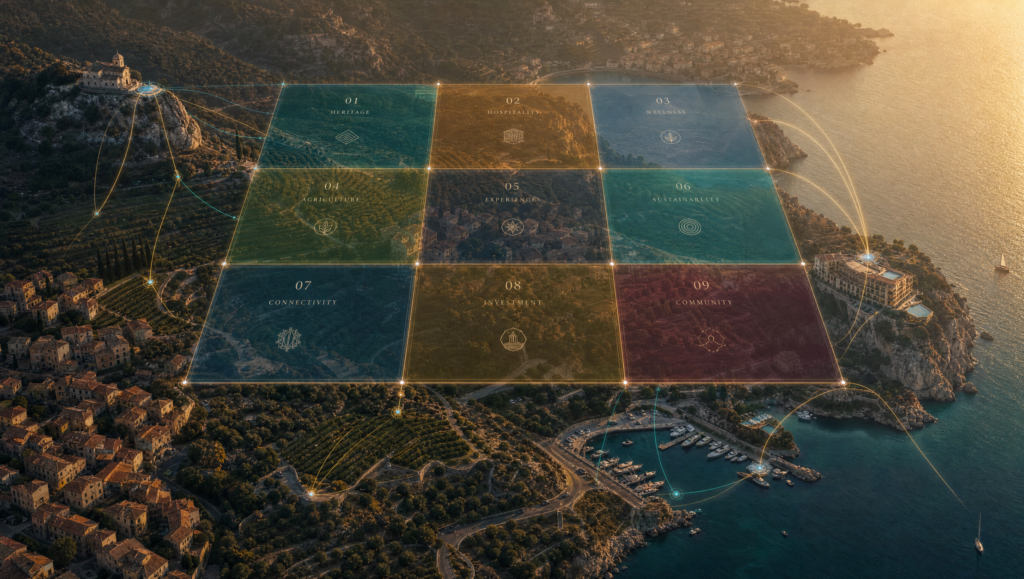
It's not a checklist. It's not an audit. It's a structured self-assessment across 9 dimensions and 5 maturity levels each, designed to give a realistic picture of where an organization actually is — not where it would like to be.
The 9 dimensions cover: Strategy and Vision, Data Foundations, Content and Creativity, Visitor Experience, Internal Operations, Governance and Ethics, Partnership and Ecosystem, Measurement and ROI, and AI Visibility and Stewardship.
The tool is online, free, no registration required, and released under a CC BY 4.0 license as a companion to the AI Tourism Playbook. It can be used in three modes: individual self-assessment before a strategic cycle, team work in a facilitated workshop (with post-its!), or as a benchmarking baseline between DMOs that want to compare notes.
The DMOs generating the most solid results with AI — Singapore, VisitAarhus, VisitScotland, Brand USA, Destination Toronto — share one characteristic that predates their technology choices: they knew where they were before deciding where to go.
I hope this contribution proves useful — and please do share your thoughts in the comments!
Find everything here → https://playbook.bereadyfor.ai/destination-ai-canvas/
Originally published in Italian by Mirko Lalli on Officina Turistica. Translation preserves the author's original voice.
Read the original (Italian)